






|
|||||||||||||||||||||||||
![]() |
![]() ![]() ![]() |
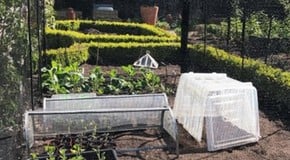
KITCHEN GARDEN UPDATE AUGUST 2008 As British athletes continue to add to their impressive Olympic medal haul in Beijing, we’ve decided to award the August weather with a honour too – a gold in persistent rainfall! The wet stuff has played havoc with the plants and Sharon’s had to contend with the threat of mildew (both downy and powdery), along with the disruption to her seed collecting activities and the angst of non-ripening sweetcorn. Still, it’s saved her a few hours of watering! In between rolling out her prayer mat and calling for sunshine, Sharon’s fallen into a busy routine of harvesting, trapping pesky earwigs and admiring her squadron of pollinating insects – attracted by the vivid colours of the sunflowers, godetia, sweet William and the many other companion plants she religiously raised and planted earlier in the year. And during those frequent spells of wet weather, our intrepid Kitchen Gardener has been busy designing and creating some informative, imaginative and very colourful signs, each displaying details of the plants currently growing in the beds. So put up your umbrella, flip open your laptop and use the latest passing shower to catch up on what’s been happening in our Kitchen Garden this month. And if the rain shows no sign of abating, you can always dip into our Garden Forum (you’ll find the link at the top of this page) for horticultural news, views and info. Now where is that sun...?
Squashed in Tight! Most gardens have a bed or area which is noticeably shadier or cooler than the others – and let’s be honest, it’s the last pick when we’re planning our planting. In the Kitchen Garden it’s poor old Bed 3 which gets no more than a cursory glance, although to be fair, it’s played a big part in producing more than healthy potato and onion/carrot/shallot crops respectively over the years. Due to the constraints of crop rotation, introducing a sun-loving set of plants to Bed 3 was inevitable and Sharon’s decided that this is the year to discover how various squashes enjoy the shady delights. “We’ve planted Butternut, Kuri and Scallop squashes,” she reports from the shady depths, “and the Orange Spaghetti squash (grown from home-saved seed) have already produced some nice yellow fruits. Yes, it is the coolest of the beds and as a result mildew is sure to take hold sooner rather than later, but I’ve got some plans to help slow down this process,” she says. “I can remove dead leaves promptly, cut back some of the rather rampant growth to help air flow and support the climbing varieties (again helping air circulation).” Watering, especially the aerial variety, can greatly increase the onset of powdery mildew, so what has Sharon done to combat this? “I’ve installed a soaker hose for watering so I do not water the foliage,” is her reply; “and I hope that the rich soil mix they are growing in will power them on through their growing season!” So, on the evidence of this year’s efforts with the squash, don’t be too hasty to ignore that damp, sun-starved little corner of the garden – it might just surprise you!
Nothing Sweet about Me! Not only the title of teenage Australian pop princess Gabriella Cilmi’s hugely successful debut single, but a fair synopsis of our Kitchen Garden sweetcorn! Sharon’s been practically begging for some sun to help the golden cobs ripen but so far, August has failed to deliver. Reports a panicky Sharon; “the wet and cold we are experiencing is not going to do the crop any favours, even though I’m feeding the plants regularly. I’m growing Golden Bantam and Tuxedo varieties - grown in separate 'blocks' to stop cross pollination - and both are highly revered by earwigs, so I’ve had to install a few hi-tech earwig traps (upturned pot and straw) to stop them nesting in the cobs and munching the kernels”, she laughs. Staring at the leaden August skies soon dissipates her smile however, as the key to this particular crop’s success is sunshine – and lots of it! And if the cobs escape the attention of the pincer-led earwig army, and manage to ripen to an edible state, here’s a little tip to check they are ready to eat; stick a sharp (and clean) fingernail into one of the kernels – if the liquid which oozes out is clear, leave them; if it’s milky, then you’re in business!
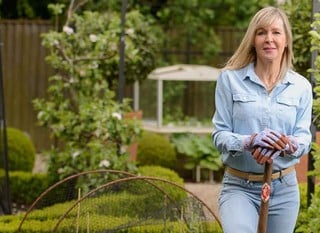
Sign of the Times! Walk round any well-kept productive garden and you’ll want to know, and most probably will be able to find out, what is growing in each bed. Up till last month you’d have struggled to find out this information as although the Kitchen Garden beds were, and still are, jam-packed with plants – both edible and companion – there were no labels, boards, panels or names to give any indication what these plants were. I’m glad to say that’s all changed now and thanks to Sharon’s creative touch, you can identify – in glorious colour with decorative illustrations no less – exactly what lives where. The artist herself explains; “Stephanie and I decided we needed to make the garden as easy and accessible as possible. I’m not always on hand to direct her to the right beds and she doesn't want to mess about when hunting for ingredients for the kitchen - it’s good for any visitors too! I’ve used chalk boards marked up with special waterproof markers so they can be changed as the garden changes too.” If your artistic abilities are not as advanced as Sharon's, follow my lead and invest in a digital plant labeller and a handful of plastic labels!
Sowing the Seeds! I’ll steer clear of another musical link (Tears for Fears, anyone?) and inform you of Sharon’s efforts to collect and store seed from successful varieties of plants, despite the damp and inclement weather. Not only is saving seed cost effective, but you know how the varieties will behave and grow in your own unique garden. You can read an article by my old Oaklands College buddy Tom Petherick on this very subject in the Daily Telegraph, but in the meantime here’s Sharon’s take on the process; “Yes I am saving some marigold, sweet-pea and annual seeds, and I’ll be collecting tomato and courgette/squash later on. The wet doesn't help though as you want to collect the seeds as dry as possible.” Is it hard? Err, no! “I pull up the plant, turn upside down and place in paper bags,” she says.
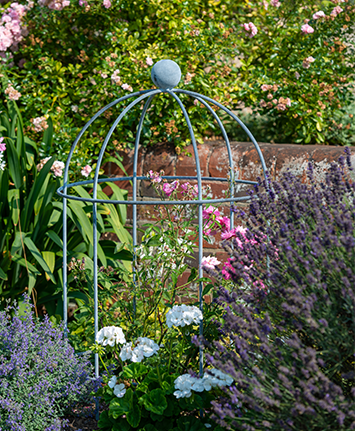
And last month… You might remember from my last e-mail update (subscribe with your e-mail address at the top of this page) that the garden was enjoying a bean-fest! Both runners and broads were being regularly harvested and Sharon’s been so impressed, she’s put up a maypole climbing frame and already the runner beans are shooting up the wires. Reports she danced around it beforehand are unconfirmed!
What else? Well, in my opinion at least there’s been a noticeable decrease in the garden slug population following the introduction of hedgehogs Twiglet and Zoe, which brings me nicely onto a very valid point made by Fiona McDonald in an e-mail. Fiona asks; “ Love the idea of using hedgehog power to combat the slug problem but with a vegetable garden there are always lots of nets - how are you getting around this problem?” And Sharon’s reply? “Yes, it was a concern. All netting in the garden is either fixed down tight using cling-ons and pegs with no slack or spare hanging down or of too finer gauge to cause a problem.” And that’s a thought for all gardeners to take on board at this time of year as slug-munching little hogs forage even harder for food with a view to fattening up for hibernation – finding a hedgehog snared in your garden netting is not a pleasant experience. Also fattening up – but that’s the result of a recent, and we have to say well-earned holiday – is Dave, pragmatic protector of the formal gardens surrounding the Kitchen Garden. He’ll soon work off the excess though he’s about to implement his autumn lawn scarifying programme – the physical part of scarifying will be the easy part for Dave as before that he’s got the tricky task of choosing his weapon; “shall I go for the hollow tine aerator, use the wolf version or put my faith in the Sneeboer scarifying rake,” he muses. He’ll probably still be thinking about it next month! That wraps up the garden news for August but if you hunger after more gardening information, feast on our extremely popular Harrod Horticultural weblog - accessible from the Garden Forum link on this page – a veritable club sandwich of horticultural news and views! And I’m always on hand at martin@harrod.uk.com with any gardening views, comments, problems or projects you have on the go!
Martin
|
![]() |
||||||||||||||||||||||
|