




Home
Search our Site
Request a Catalogue
Three pronged attack...!    

Dear Martin...

I would welcome your advice on the best way to tackle the two problems of weeds and pests (rabbits/pigeons) in my garden.

We have more than an acre of very fertile soil in the countryside in south east Scotland. It is completely wild, and covered in rose bay willow herb, nettles, celandines, etc and lots and lots of chickweed with some spuce trees dotted about.

Over the past eight years or so, with a lot of blood, sweat and tears I have gradually dug over and expanded a veg patch which is now about 12m by 15m. As you can imagine it has been quite a struggle. It has to be fenced because of rabbits and most things have to be netted because of pigeons. At the moment it has a ramshackle home made fence round it which I have constructed from odds and ends of chicken mesh which is then surrounded by slabs. It is laid out in beds with odd bits of old garden edging to stand on in between. Some of the beds are covered in netting with home made constructions which make weeding difficult and inevitably you end up tramping on the beds.  The rose bay willow herb and nettles are constantly encroaching through the fence and it is an ongoing battle to keep control. Despite this it is very productive, and I have simply had to develop a serenity about the weed issue.

ANYWAY...I have decided the time has come to try and sort things out a bit but I am uncertain what the best way to proceed is. I am aware that whatever I do there will need to be quite a financial outlay.  I want to change it all into raised beds and expand it to about twice the size so I can have more fruit bushes etc .I also want a greenhouse or polytunnel. Everything has to be rabbit proof. (There is no plan to tame the wilderness apart from the veg patch area since it is actually really beautiful and a haven for all sorts of wildlife and wild flowers). 

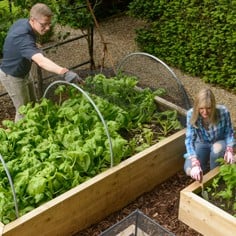
I wondered about having individual cages for each bed and no fence at all. Then I could avoid the problem of the encroaching perennial weeks by strimming more easily without the problem of snagging on the fence. There are various constructions available at Harrods Horticultural to fit over individual raised beds but I'm not sure how adequate they would be to keep out a determined rabbit.

Or perhaps individual cages is a daft idea and it would be better to simply have a more robust perimeter fence of some sort for the rabbits with raised beds and simple bird netting inside? Alternatively a very large fruit cage or a couple of fruit cages to cover at least some of the area, Neither of these options would however, solve the fence/weed encroachment problem and I am also concerned about creating frost pockets and wind eddies with a solid fence (and believe me it is windy and frosty enough here already!!)

I'm just not sure how to proceed and am going round in circles. I would welcome your thoughts.

Aly
     
Martin says...
 
Dear Aly
 
Many thanks for your recent and very detailed message about your current vegetable plot problems and plans for expansion. 

I think you’ve already identified that the road to tidying your garden forks in two directions, and the first way sees a fruit cage covering the entire area giving you the freedom to work inside with the crops safe from rabbits and birds. As you say, this is likely to be the most costly solution and doesn’t solve the weed problem but does offer you a completely protected environment in which to grow, with possibly only any brassicas plants requiring extra netted protection from cabbage white butterflies. If you’d like us to quote for a cage to cover the area, have a measure up, drop us the dimensions and we’ll give you an idea of price.
The second route you could take – and I think this is my slight favourite but don’t let that sway you! – is to install a rabbit proof fence around the perimeter of the area you wish to grow in. This method has the advantage of being much less expensive and a fence made from galvanised rabbit wire (don’t forget to dig it in the ground around 6” and curve it underground in a lip away from the fence to deter rabbits from digging downwards at the fenceline) and wooden posts will look attractive, will act as some kind of windbreak but shouldn’t create a frost pocket or any kind of wind eddy. You could also tap into the valuable resource you have – the weeds – by allowing them to colonise the wire and create a ‘living fence’, providing both a food source and refuge for a large number of beneficial insects and pest predators. 

And method this could open up a way to combat the weed encroachment as well! Let them have the fence as described above along with a small margin inside and instead of strimming, use a lawnmower to run around the inside of the perimeter; this should be easier than strimming and cause little or no damage to the fence.
Of course, the crops growing in beds inside this outer fence will still need some kind of protection from the birds but only having to concentrate on one form of attack will allow you pick less expensive covers and nets which don’t necessarily need to be in place all year round, allowing you rotate the netting. Access to the plants will also be easier too, which I’ll come on to... 

Back onto a general theme and you might want to consider constructing permanent pathways between the beds. You don’t have to get involved in any civil engineering tasks; clearing the area of weeds, scraping off the top inch or so of turf or soil and laying down some ground cover or mulching fabric covered in a good depth of bark for example (at least 2”) will create a suitable walkway and remove the job of removing encroaching weeds from the calendar, along with neatening the appearance of your plot. 

Finally, your suggestion of covering individual beds and although this is a nice idea, each bed would need to be fortified to prevent both rabbit and bird forays. Our anti-bird netting will take care of the latter but rabbits are a cunning lot and you’d probably need to reinforce the bird netting with rabbit wire to stop them nibbling through. This would make removing the cover to gain access for harvesting or weeding almost an all day task, so I’d be inclined to place this particular method at the bottom of the list!

And that’s about it! In summary, I’ve suggested two main alternative solutions which you can take away and see which best fit your location and budget. No doubt you’ll have a few further questions which spring to mind and please don’t hesitate to contact me with them; I’ll do my best to provide you with answers and ideas!
Martin   
 
Newsletter Sign Up
Buy fruit cages, garden supplies and greenhouse equipment online from Harrod Horticultural (UK).
e-commerce by screen pages