









Kitchen Garden Update February 2006 - Planning for the Future
As we are well into the New Year, garden thoughts have turned to the spring and summer and what will be growing in the Kitchen Garden. If ever a plan was required, it's now!
You may remember that this time last year, we were up to our woolly hats in turf and yew roots as the Kitchen Garden site was cleared. At the time, I remember thinking, as the rain pelted down and the wind howled, how glad I as that this was a one-off job and that this time next year would be much less stressful. After spending many, many hours trying to formulate a crop plan that would keep everyone happy, now I’m not so sure!
As you may be aware, Harrod Horticultural have introduced an exciting new range of organic seeds and plug plants this year, and my brief was to include all the seed range and as many as the live plants as possible in the cropping plan for this year. This was a good starting point as I could then place the seeds/plants into families – for crop rotation purposes – and proceed to work out what protection each bed of plants will require, which pests and diseases are likely to attack and when (which pests are NOT likely to take a shine to the plants would have been easier!) and, as a new project, which companion plants will prove beneficial.
After many hours` burning the potting shed midnight oil (or 60 watt bulb), the plan is complete in every detail. But you know what they say about all the best laid plans, etc? You can never be totally sure what Mother Nature will throw at us (it’s snowing as I write this) so although the plan will no doubt prove invaluable, some degree of flexibility will be required – and that’s why the plug plants will prove very handy if we’re pushed for time.
So what’s on the masterplan? I’ve reproduced the overall Kitchen Garden Plan below so you can identify the beds by number, and it goes something like this;
Bed 1; Beans and Peas, followed by Peppers. Expecting visits from Black Bean Aphids, Pea Aphids, Slugs and possibly the Pea Moth. Companion planting with Dill, Nasturtium, Summer Savoury, Tagetes and Sage.
Bed 2; Asparagus, Artichokes, Garlic and Herbs. Slugs and Black Bean Aphids are likely to appear if last year is anything to go by. Summer Savoury is the companion.
Bed 3; Potatoes! 1st early, 2nd early, early maincrop, and 3 late maincrops. Slugs and potato blight is bound to affect the crop, and Tagetes is the companion plant.
Bed 4; Onions, followed by Beet Leaf, Chard, Lettuce, Cucumber, Courgettes and Summer Squash. Slugs of course will be present, and powdery mildew on the curcubit leaves is likely to appear in the autumn. Also growing Dill.
Bed 5; Brassicas and Sweetcorn. Looking forward to plagues of slugs, leatherjackets Cabbage White Butterflies and Cabbage Root Fly, and growing Dill and Sage to repel.
Bed 6; Salad Crops and Broccoli with all of the above pests along with birds. Charvil should help.
Bed 7; Leeks, Onions, Carrots and Beetroot. Carrot Root Fly and Black Bean Aphids are predicted to gatecrash the party, and a mixture of Carrot, Onion, Sage, Dill and Nasturtium should help keep pests at bay.
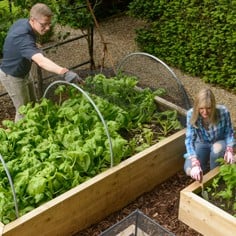
The two raised beds next to the greenhouse (please ignore the third; we ran out of room to construct it) will contain courgettes and dwarf French beans respectively, the fruit cage has already been planted up with blackcurrants, raspberries and blueberries and the strawberries are tucked away alongside the fruit cage – they were planted last year.
Greenhouse crops are various tomatoes, some aubergines and sweet potatoes – pests love the atmosphere in the greenhouse and we fully expect visits from whitefly, aphids and red spider mites – but we are ready!

So there it is! Obviously, this is a very truncated version of the whole document, but enough to give you a flavour of what 2006 will be like in the Kitchen Garden. You can check the individual varieties of the various crops we intend to grow in the Harrod Horticultural catalogue (pages 93 to 95), and if you have any comments on, or experience of, preparing a crop plan, visit our popular – and invaluable – weblog, or Garden Forum; simply click on the Garden Forum link at the top of this page and join the army of gardeners who have already posted comments and questions.
But don’t think the whole month was spent preparing the plan! The greenhouse has been thoroughly cleaned inside and out (structure and equipment), pots and trays have been washed down, beds have been prepared and the potting shed has been fitted out.
Roll on Spring!