









Kitchen Garden Update
Late April 2005
Amid the tranquil surrounding of the Kitchen Garden, a fierce battle is raging. The brassica bed, planted up with alternate rows of broccoli, brussel sprouts and cauliflower, is the setting for this conflict with the ultimate gardener’s enemy, the slug. Welcome to the Kitchen Garden Slug Special! Widely recognised as the gardener’s biggest foe, these slugs have decided to munch their way through as many of the young brassica plants as possible, and left alone to do so, it appears they could possibly consume the entire bed. However, we are not prepared to allow our brassicas to meet a slimy end so, keeping within the organic boundaries which form the whole ethos of the Kitchen Garden, we have decided to fight back.
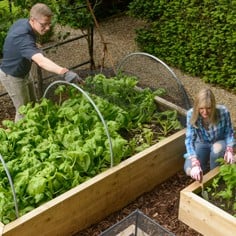
We have introduced various methods of prevention, many of which will be familiar to gardeners of all ages. Firstly, the physical barriers of copper rings have been placed around a number of plants, after carefully checking the soil inside the ring is free from any marauding mollusc. These rings can be opened out as the plant inside becomes larger so as not to restrict growth in any way, and eventually replaced with a larger size if and when required. We are very pleased with the success of this form of protection.

Secondly, we introduced the slug granules which, when piled up around the stems of the plants, have a dual deterrent. The sharp, uneven surface is difficult for slugs to cross and the granules also help dry up the bed of mucus on which these utter pests glide around upon, making a trip to the juicy leaves extremely uncomfortable. Again, these granules are proving an important weapon in this confrontation.

A slug trap has also been introduced, baited for the moment with specialised slug bait which certainly seems very palatable to our slimy opponents. This trap has caught numerous specimens, up to as many as 16 in one night, and beer can also be used as an attractant. This news has our intelligence division conducting in depth research into which flavour will prove most suitable with the thankless task of endless testing ongoing!
Perhaps the most exciting weapon at our disposal are the nematodes. This is an example of biological control, a method which utilises one living organism to control another naturally, and an area of horticulture which although initially developed as long ago as the 1920’s, is still seen as a relatively modern development. For organic gardeners’ like ourselves, this type of control is both very useful and very popular. These particular microscopic nematodes are applied to the soil via a watering can and actively seek out all species of slugs, (probably best not to read on if of a squeamish disposition), entering the creature through any pore or opening and spreading bacteria which kills the slug below ground.

We are sure that all horticulturalists have had their own skirmishes with this common enemy and we would love to hear of any successes, or even glorious failures – please contact us with any information or recollections you may have and please keep visiting us for further updates, when we will keep you informed of all the latest Kitchen Garden news.